 HISTORY
of
CLAN JOHNSTON

Twenty generations
ago and you're back in the 14th century. The French nobility is being defeated
at Courtrai, William Wallace is being betrayed, Robert the Bruce is crushing
the English cavalry at Bannockburn, The Declaration of Arbroath is being
penned, Scottish blood is being shed, Scottish victories are being won,
Scottish history is being written .......... Johnston ancestors were there.
This is the history of Clan Johnston.
 The
Place
The
Place
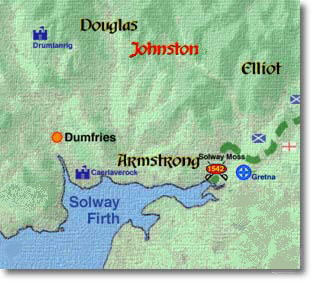
The Johnstons were at
one time the most powerful of the Border clans. They originally settled
and occupied Annandale, near Dumfries, and have held extensive holdings
in the western marches for over 600 years. Sir John Johnstone, Knight
of the county of Dumfries, swore fealty to Edward I of England in the Ragman
Roll of 1296.
Adam Johnstone, was Laird
of Johnstone before 1413, and took part in the Battle of Sark in 1488.
His son sided with James II in his struggle with the Douglases. He was
rewarded with a grant to the lands Buittle and Sannoch near Threave Castle,
formerly part of the Douglas lands of Galloway. Adams eldest son,
John, was the progenitor of the Annandale or main branch of the family,
while another son Mathew, was ancestor of the Westerhall branch.
Lochwood Castle is the seat of Johnston.
The Name
Clan Johnston consists
of at least two distinct groups, those of Annandale in Dumfries and Galloway,
and those of Caskieben in Aberdeenshire, as well as Johnston(e)s who cannot
easily be classified as either, such as those who took their name from
the former name of Perth (St. Johnstoun) or other places called Johnston
or Johnstone.
A wee word aboot pronunciation
and spelling: In Scotland, generally the name is pronounced "Johnston",
no matter how it is spelled; native border Scots often pronounce it "Jawnson."
Those from North America, however, tend to pronounce Johnstone as "Johnstoan"
and Johnston as "Johnston" suggesting two different names. There is only
one name, one clan, and one great history.
The Head of the House
of Johnston of Caskieben spells his name "Johnston" while the present,
Chief of the Clan spells his name "Johnstone," Either spelling is used
by Annandale or Caskieben clansmen.
In the Beginning
The derivation of the
name is Anglo-Saxon and means "John's settlement" The first known Johnston
was Gilbert, the son of John, who received use of a small parcel of land
in southern Annandale from William Bruce, Lord of Annandale, between 1195
and 1214. Gilbert soon was knighted and witnessed various charters as Sir
Gilbert de Joneston. Later Johnston lairds fought the English at the Battle
of Solway in 1378 and the Battle of Otterbourne in 1388.
The Johnstons of Annandale
were the most fearless receivers of the Scottish West March of the Borders.
Scotland’s Western Border was defended from foreign invasion and alien
rule by clansmen who proudly bore the name Johnston, Johnstone, Johnstoun,
Jhonstowne, or Joniston. They fought on a cruel and harsh frontier. Centuries
of border warfare, in which the Scots frequently lost all their possessions
to the English, left the border warriors less interested in growing crops
and instead, developed the prized military skills of guerilla warfare.
The borderers raided the English and traitorous neighboring clans to replenish
the cattle and horses which had been stolen from them. The Johnstons were
outstanding horsemen and, dressed in a steel helmet (tin bunnet) and reinforced
leather jacket (jack), with a lengthy lance, cutting sword and set of pistols,
a Johnston clansman was well tailored for the environment.
Royal Blood
On 25 March 1306 Robert de Brus,
Earl of Annandale, and ancestor of the Johnston, was crowned King of Scots at
Scone in the presence of four bishops, five earls and the people 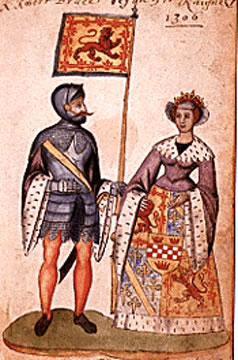 of
the land by the Countess of Buchan. The King of Scots became King Robert I and
in 1314 he killed Henry de Bohun at the commencement of the Battle of Bannockburn.
This famous victory by the Noble Johnston led to the finest day in Scottish
independence, 6 April 1320: The Declaration of Arbroath. An extract from this
historic document reads…
of
the land by the Countess of Buchan. The King of Scots became King Robert I and
in 1314 he killed Henry de Bohun at the commencement of the Battle of Bannockburn.
This famous victory by the Noble Johnston led to the finest day in Scottish
independence, 6 April 1320: The Declaration of Arbroath. An extract from this
historic document reads…
"…for so long as a
hundred of us are left alive, we will yield in no least way to English
dominion. We fight not for glory nor for wealth nor honours; but only and
alone we fight for freedom, which no good man surrenders but with his life."
This letter was from Scottish
barons to Pope John XXII, affirming their determination to maintain Scottish
independence and support King Robert I unless he showed signs of yielding.
Four hundred and fifty years later there were echoes of the Arbroath Declaration
in the American Declaration of Independence in 1776. Once again Johnston
led the way!
Robert the Bruce, King
of Scots, died at Cardross Castle 7 June 1329.
The Lands
and Peoples
Border lairds lived in
stark, square stone peel towers, three or four stories tall, surmounted
with battlements and built on near inaccessible ground. The principal stronghold
of the Johnstons was Lochwood Tower, a massive, L-shaped fortress surrounded
by forest and marsh. The Johnstons rose to prominence and power by assisting
the King in crushing the Douglas rebellion 1455. The Black Douglases virtually
controlled southern Scotland and were perceived as a serious threat to
the Stewart dynasty. The Johnstons fought the Black Douglases at Arkinholm
in Dumfriesshire and participated in the King's siege of Threave Castle
in Kirkudbright. The Douglases were attainted, their estates forfeited,
and King James II rewarded his supporter, including the Johnstons, with
grants of former Douglas lands. Johnston clansmen then spread throughout
upper Annandale and into Lanarkshire. In 1542 Queen Mary of Guise erected
the lands of the Laird of Johnston into a free barony.
During the sixteenth century
the Johnstons and the Maxwells competed for dominance in the Scottish West
March. Johnston and Maxwell chiefs each served at various times as Wardens
of the Scottish West March. Their respective clans continued a deadly blood
feud for almost a century. In late 1593 John, seventh Lord Maxwell, Earl
of Morton, sometime collaborator with the Spanish armada and Warden of
the Scottish West March, assembled 2,000 armed horsemen and, displaying
the King's banner, invaded the mountainous district of Annandale, land
of the Johnstons. Whatever the official reason, Lord Maxwell's personal
intention was once and for all to destroy his family's ancient enemies
and rivals for power in southwestern Scotland.
Sir James Johnstone of
Dunskellie, Chief of the Johnstones, received advance warning of the approaching
army and realized that his clan would soon have a desperate fight for continued
existence. He summoned help from the Grahams, Scotts, Carrutherses, Irvings,
Elliots and others, and quickly raised a defensive force of perhaps 800.
Among those who came to the aid of the clan was the Chief's eleven-year-old
kinsman, Robert Johnstoe of Raecleuch. Lord Maxwell had offered his followers
a reward for the head or hand of the Laird of Johnston, and Sir James in
turn offered his followers a reward for the head or hand of Lord Maxwell.
As the battle raged, and
in the midst of carnage Lord Maxwell foresaw his folly of attacking Johnston
and offered to surrender, but the Johnstons, unwilling to yield to a treacherous
terrorist cut off his outstretched arm and slew him as he deserved. It
is said that the Laird of Johnston affixed the head and right hand of the
villainous Maxwell to the battlements of Lochwood Tower as bloody trophies
of the Johnstons' overwhelming victory at the Battle of Dryfe Sands.
In 1608 a meeting was
arranged for a reconciliation of Sir James Johnston of Dunskellie and the
new Lord Maxwell, son of the chief who was killed at the Battle of Dryfe
Sands. Precautions were taken for each to bring only one attendant. During
the interview, Lord Maxwell suddenly drew a pistol from under his cloak
and with cowardice shot the heroic Johnston chief in the back with two
bullets, that he had previously rubbed in poison, mortally wounding the
refined campaigner. After escaping to France, Lord Maxwell was finally
apprehended and publicly beheaded in Edinburgh for his "murder under trust"
of Sir James Johnston of Dunskellie. Can a Maxwell ever be trusted!
When King James VI of
Scotland also took on the throne of England in 1603, the border frontier
became the heart of a new united kingdom. In the King’s proclamation of
1605 he forbade borderers, "except nobles and gentlemen unsuspected of
felony or theft," from carrying "jacks, spears, lances, swords, daggers,
steel caps, hackbuts, pistols, platesleaves, and suchlike." It also forbade
the owning of any horse above the value of 30 Scottish pounds. The government,
now in England, deported or executed many Johnstons. The border frontier
ceased to continue within a few short years.
In 1633 at the coronation
of King Charles I in Scotland, James Johnstone, son of Sir James Johnston
of Dunskellie, was created a first lord of Parliament with the designation
of Lord Johnston of Lochwood. In 1643 he became Earl of Hartfell, Lord
Johnston of Lochwood, Moffatdale and Evandale. During the religious wars
the Earl joined the Covenanters, but later supported the royalist cause
under Montrose. The Covenantor army captured the Earl at Philliphaugh in
1645 and condemned him to death, but later commuted the punishment to a
fine of 100,000 pounds Scots. During the Commonwealth, the Earl of Hartfell
and his son were imprisoned in Edinburgh, Dumbarton and St. Andrew’s castles.
Upon the Restoration, King Charles II rewarded James, the second Earl of
Hartfell, for loyalty with a crown charter to the Earldom of Annandale.
William Johnston, the
second Earl of Annandale, participated in a Jacobite plot as a youth, but
eventually regained the favor of King William I and became an Extraordinary
Lord of Session, Lord of the Treasury, Lord of the Privy Counsel, Knight
of the Thistle, Joint Secretary of State for Scotland, Keeper of the Great
Seal, and Privy Counselor.
In 1701 the King made
William the Marquis of Annandale in recognition of his service. His oldest
surviving son, James, the second Marquis of Annandale, died unmarried in
Naples in 1730. The first Marquis's posthumous son, George, was the third
Marquis and when he died unmarried in 1792 the titles became dormant.
Today
In 1983, after a lapse
of nearly two centuries, the Lord Lyon King of Arms officially recognized
Major Percy Wentworth Hope Johnstone of Annandale and of that Ilk, hereditary
Keeper of Lochmaben Castle and a descendant of the daughter of the first
Marquis of Annandale, as Chief of Clan Johnstone. Upon Major Hope Johnstone's
death later that year, his son Patrick Andrew Wentworth Hope Johnstone
succeeded as Chief. In 1985 the House of Lords recognized the Chief's claim
to the long-dormant titles of Earl of Annandale and Hartfell. The Chief
resides with his wife, Countess Susan Josephine Ross Hope Johnstone at
Raehills on their Annandale estate. They have a son, Lord David Johnstone,
and a daughter, Lady Julia Johnstone.
Chronology
of 13th and 14th Centuries
o 1274 - Birth of Robert
Bruce on 11 July.
o 1286 - Death of Alexander
III. Election of guardians. The Turnberry Bond.
o 1289 - Treaty of Salisbury.
o 1290 - Treaty of Birgham.
Death of Maid of Norway. Edward I invited to arbitrate.
o 1291 - Edward I accepted
as superior lord of Scotland.
o 1292 - Balliol crowned
and renders homage. Edward I repudiates Treaty of Birgham.
o 1293 - King John (Balliol)
summoned before English Parliament and convicted of contumacy.
o 1294 - War between Edward
I and Philip IV of France. Welsh revolt.
o 1295 - King John replaced
by Council of Twelve. Treaty between France & Scotland. Bruce's grandfather
dies.
o 1296 - Outbreak of war
between England & Scotland. Sack of Berwick. King John abdicates. The
Ragman Roll.Freeholders pay homage to Edward I.
o 1297 - Insurrection. Andrew
Moray, William Wallace. Capitulation of Irvine. Battle of Stirling Bridge.
Andrew Moray dies of wounds.
o 1298 - Wallace knighted
and appointed guardian. Edward I invades Scotland. Battle of Falkirk. Bruce
& Comyn appointed guardians.
o 1299 - Lamberton third
guardian. Scots take Stirling Castle.
o 1300 - Bruce resigns guardianship.
Replaced by de Umfraville. English invasion. Truce.
o 1301 - Soulis appointed
sole guardian. English invasion.
o 1302 - Truce. Bruce submits
to Edward I. Marries Elizabeth de Burgh.
o 1303 - Battle of Roslin.
Peace treaty between France & England, excluding Scots.
o 1304 - Bruce's father
dies. Comyn surrenders. Bond between Bruce & Lamber ton. Stirling captured
by Edward I.
o 1305 - Wallace captured
and executed. New ordinance for government of Scotland.
o 1306 - Death of Comyn.
Douglas joins Bruce. Bruce crowned at Scone: defeated at battles of Methven
and Dalry: escapes to Dunvarty and then to Rathlin. His brother Nigel captured
at Kildrummy Castle and executed. His wife, sisters and daughter captured
at Tain.
o 1307 - Bruce lands at
Turnberry. Guerrilla war in southwest Scotland. His brothers Alexander
and Thomas captured in Galloway and executed. Bruce defeats English at
Glen Trool and Loudon Hill. Rising in Moray. Edward I dies. Bruce moves
north, falls ill.
o 1308 - Battle of Inverurie.
'Herschip' of Buchan. Battle of Brander. Earl of Ross submits to Bruce.
o 1309 - St. Andrews parliament.
Scotland north of the Tay under Bruce's control.
o 1310 - Edward II invades
Scotland.
o 1311 - Bruce raids northern
England.
o 1312 - Bruce raids northern
England again. Treaty of Inverness between Scotland & Norway.
o 1313 - Bruce captures
Perth. Reconquers southwest Scotland and Isle of Man.
o 1314 - Douglas captures
Roxborough. Randolph captures Edinburgh. Battle of Bannockburn.
o 1315 - Act of Succession.
Marriage of Princess Marjorie. Edward Bruce invades Ireland.
o 1316 - Edward Bruce crowned
King of Ireland. Death of Princess Marjorie.
o 1316 - Bruce campaigns
in Ireland.
o 1318 - Berwick taken by
Scots. Edward Bruce slain in Ireland. Succession to Scottish throne by
Robert Stewart.
o 1319 - Edward II besieges
Berwick. Randolph & Douglas invade England. 'The Chapter of Myton'.
Two-year truce.
o 1320 - The Declaration
of Arbroath. Soulis's conspiracy.
o 1322 - Edward II's last
invasion of Scotland. Bruce raids England. Defeats Edward II at Old Byland,
Yorkshire.
o 1323 - Harclay attempts
peace treaty. Executed by Edward II. Official negotiations lead to thirteen-year
truce.
o 1324 - Pope recognizes
Bruce as King of Scotland. Queen Elizabeth gives birth to male heir.
o 1326 - Treaty of Corbeil
between France & Scotland. Succession to Scottish throne settled on
David Bruce.
o 1327 - Deposition of Edward
II. Truce broken. Edward III advances on Scotland. Bruce invades Northumberland.
o 1328 - Treaty of Edinburgh.
Marriage of David Bruce to Edward III's sister Joan.
o 1329 - Death of Bruce,
7 June.
